
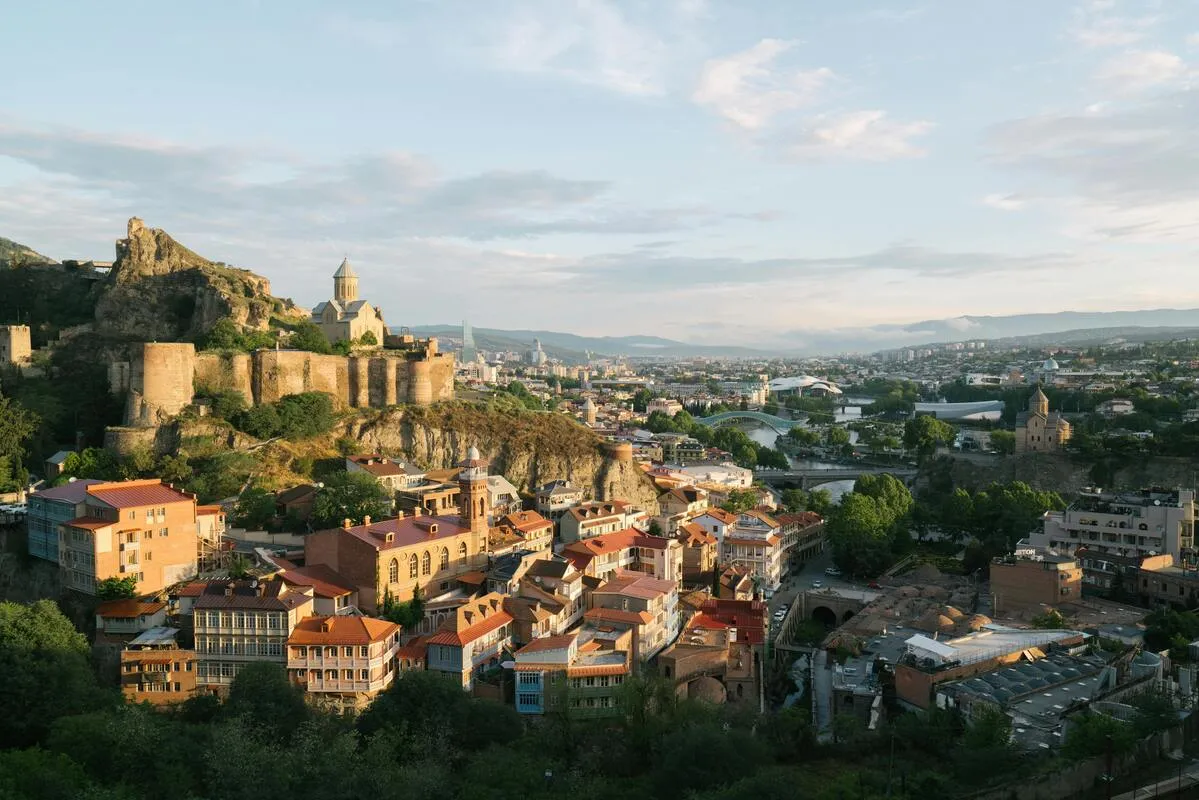

Introduction
Gamarjoba! (That's "hello" in Georgian.) Not the US state with the peaches: this is the country in the Caucasus, between the Black Sea and the Caspian, that has become one of the easiest places in the world for long stays.
Citizens of more than 90 countries can stay for up to a year without a visa, living costs are well below Western Europe's, and Tbilisi has a large remote-worker scene. This guide covers the visa rules as they stand in 2026, what things cost, the main cities, taxes and the practical side of settling in, with links to the official sources.
What changed in 2026: since 1 January 2026, visitors must have travel health insurance covering at least GEL 30,000 for their whole stay; since 1 March 2026, foreigners working for Georgian employers need a work permit; and in April 2026 Parliament created a C5 visa for remote workers, applied for through the official Georgian e-Visa portal.

Kartlis Deda, the Mother of Georgia statue, looking over Tbilisi
Visa Programs
Georgia's visa situation is refreshingly simple compared to most countries. Compare it with other options in our visa comparison tool if you're still deciding where to land.
- Visa-free stay: citizens of more than 90 countries, including the EU, UK, US, Canada and Australia, can stay for up to 365 days without a visa. Since 1 January 2026 you also need travel health insurance covering at least GEL 30,000 (about US$11,000) for the whole stay, in English or Georgian.
- C5 visa for remote workers: approved by Parliament in April 2026 for people who work only for employers or clients outside Georgia. It is a multiple-entry visa valid for up to five years, allowing stays of up to a year at a time, with a US$300 fee and applications through the official Georgian e-Visa portal. It matters most if your passport doesn't give you the 365-day visa-free stay. The income threshold and document list were still being finalised in 2026, so check the portal.
- Residence permit through property: buying non-agricultural property worth at least US$150,000 (raised from US$100,000 on 1 March 2026) qualifies you for a temporary residence permit. Other routes include work, study, family and business.
- Work permits: since 1 March 2026, foreigners working for Georgian employers need a work permit; people who were already working under the old online registration have until 1 January 2027 to switch.
"Remotely from Georgia" is gone: the 2020 programme that many articles still describe as Georgia's digital nomad visa was a pandemic-era entry scheme and has been suspended. Ignore third-party sites that still "process" it for a fee.
Cost of Living
Georgia is affordable by Western standards. These figures are from Livingcost.org's city data (June 2026); compare cities, or see costs for a family, in our cost of living calculator.
- Tbilisi, one person: about $1,010 a month with a 1-bedroom flat outside the centre, or $1,225 in the centre
- Rent in Tbilisi: about $413 a month for a 1-bedroom flat outside the centre and $628 in the centre
- Batumi, one person: about $831 a month (1-bedroom outside the centre $308, centre $405)
- Kutaisi, one person: about $715 a month (1-bedroom outside the centre $237, centre $315)
- Public transport: 1 GEL per ride in Tbilisi (metro, buses and minibuses), valid for 90 minutes
Source: Livingcost.org, June 2026. Totals include rent, utilities, internet, food, transport and other everyday costs.
Popular Cities for Expats
Tbilisi
Georgia's capital is the heartbeat of the country's expat scene. The city beautifully blends centuries-old architecture with ultra-modern designs. Old Tbilisi offers charming cobblestone streets and traditional Georgian houses with carved wooden balconies, while districts like Vake and Saburtalo provide more contemporary living options.
Best for: Digital nomads, startup entrepreneurs, and culture enthusiasts
Monthly rent: about $413 (outside the centre) to $628 (centre) for a 1-bedroom flat
Expat community: the largest in the country, with regular meetups
Notable areas: Vake (upscale), Vera (bohemian), Old Tbilisi (historic), Saburtalo (affordable modern)

Traditional wooden balconies in Old Tbilisi
Batumi
This Black Sea resort city has transformed into a modern coastal hub with a growing expat community. Pebble beaches, late nights and a subtropical climate. Batumi is a beach resort and a proper city at the same time. The city is particularly popular during summer months when the promenade comes alive with activities.
Best for: Beach lovers, seasonal residents, and those who enjoy warmer climates
Monthly rent: about $308 (outside the centre) to $405 (centre) for a 1-bedroom flat; summer short lets cost more
Notable areas: New Boulevard (modern), Old Batumi (character), Batumi Beach District (convenient)
Getting around Batumi is relatively straightforward, with public transportation in Batumi including buses and marshrutkas (minibuses) that connect most areas of the city. The city is also quite walkable, especially along the scenic boulevard area.

Aerial view of Batumi with its iconic skyline along the Black Sea coast
Kutaisi
Georgia's third-largest city offers a more authentic Georgian experience with significantly lower costs than Tbilisi or Batumi. With its UNESCO World Heritage sites, beautiful architecture, and proximity to natural wonders like the Prometheus Cave, Kutaisi provides a perfect balance for those wanting to immerse in Georgian culture while enjoying modern amenities.
Best for: Budget-conscious expats, cultural enthusiasts, and slow travelers
Monthly rent: about $237 (outside the centre) to $315 (centre) for a 1-bedroom flat

Panoramic view of Kutaisi with its historic architecture and surrounding landscape
Where to start: If you're new to Georgia, start with Tbilisi. It has the most rentals, coworking spaces and English speakers, and it's the easiest place to sort out a SIM, a bank account and paperwork. Once you've got your bearings, try Batumi for the coast or Kutaisi for lower costs.
Kazbegi (Stepantsminda)
For nature lovers and digital nomads seeking tranquility, this mountain town has huge views of the Caucasus Mountains, including the iconic Mt. Kazbek. The dramatic landscape, clean air, and slower pace of life make it ideal for those looking to escape city living while maintaining connectivity for remote work.
Best for: Nature enthusiasts, writers, and remote workers seeking inspiration
Housing: few long-term rentals; most places are guesthouses

Gergeti Trinity Church with Mt. Kazbek in the background, Kazbegi region
Borjomi
Famous for its mineral waters, this spa town sits in a forested valley and is built for slowing down. Surrounded by forested mountains and natural springs, Borjomi provides excellent hiking opportunities and a peaceful environment for health-conscious expats.
Best for: Health enthusiasts, nature lovers, and retirees
Housing: a small rental market, busiest in summer
Job Market for Expats
While many expats in Georgia work remotely for foreign companies, the local job market is also developing opportunities for internationals:
- Popular Industries for Expats:
- English teaching (high demand in language schools and private tutoring)
- Tourism and hospitality (especially in Tbilisi and Batumi)
- IT and software development (growing tech startup scene)
- International organizations and NGOs
- Digital marketing agencies serving international clients
- Local salaries: far below Western European levels, so most foreigners keep a remote income
- Work permits: required since 1 March 2026 for foreigners working for Georgian employers
- Networking: many jobs are filled through personal connections rather than job boards
- Entrepreneurship: registering a business or Individual Entrepreneur is quick, and tax rates are low (see below)
Important: Local salaries are significantly lower than in Western Europe or North America. Most foreigners living in Georgia earn from abroad.
Banking and Taxes
- Bank account: many foreigners can open an account with a passport at banks such as TBC and Bank of Georgia, without residency. Banks can ask for more documents depending on your nationality and source of funds.
- Tax residency: you become a Georgian tax resident after 183 days in Georgia in any continuous 12-month period.
- Personal income tax: a flat 20% on Georgian-source income. Foreign-source income of individuals is generally exempt, but income counts as Georgian-source if you do the work while in Georgia, so remote workers should take advice.
- Small business status (1%): an Individual Entrepreneur with small business status pays 1% on turnover up to GEL 500,000 a year, and 3% on the excess. Some activities are excluded, including consulting and licensed professions such as legal and medical work, so check before you register with the Revenue Service.
- Payment apps: Wise and Revolut work with Georgian accounts.
The tax angle: low living costs, the 1% small business regime for eligible activities, and the exemption for genuinely foreign-source income are why many freelancers look at Georgia. The rules on what counts as foreign-source income are technical; get advice from a Georgian accountant before relying on them.
Banking Security Alert: Always use ATMs attached to banks rather than standalone machines, especially in tourist areas. Shield your PIN, be vigilant about card skimming devices, and set up SMS notifications for all transactions to monitor your account activity in real-time.
Culture and Lifestyle
Georgian culture sits between Europe and Asia, with an ancient wine tradition and a reputation for hospitality that visitors notice quickly.
- The supra: a traditional feast that can run for hours, led by a toastmaster (tamada) who proposes a long series of toasts. Pace yourself: you're expected to drink after each toast, though declining politely is accepted.
- Hospitality: Georgian hosts take hospitality seriously, and guests often find it hard to pay for dinner. An invitation to someone's home is a real compliment.
- Polyphonic singing: Georgian multi-part folk singing is on UNESCO's intangible heritage list, and it's common to hear it at supras and family gatherings.
- The Orthodox Church: most Georgians are Orthodox Christian and churches are everywhere. Dress modestly when you visit: covered shoulders and knees, and women are usually expected to cover their hair.
- Family: three generations living together is common. Family ties are central to daily life.
- Doing business: relationships matter more than formal process, and meetings often move to a meal.

A traditional Georgian supra (feast) with an array of local dishes

Georgian folk dancers

Fabrika, an old Soviet sewing factory in Tbilisi that's now a hostel, coworking space and courtyard of bars Photo: Alf Altendorf, CC BY-SA 2.0, via Wikimedia Commons
Entertainment and Activities
Georgia offers a diverse range of activities for expats, from outdoor adventures to cultural experiences:
- Outdoor Adventures:
- Hiking in the Caucasus Mountains (popular routes in Kazbegi, Svaneti, and Tusheti)
- Skiing and snowboarding in Gudauri and Bakuriani during winter months
- Beach activities along the Black Sea coast in summer
- Paragliding in Gudauri with spectacular mountain views
- Cultural Experiences:
- Wine tours in Kakheti, the birthplace of wine with 8,000 years of winemaking history
- Traditional dance performances at venues like the Tbilisi Concert Hall
- Thermal sulfur baths in Tbilisi's Abanotubani district
- Exploring ancient cave cities like Uplistsikhe and Vardzia
- Nightlife:
- Tbilisi's club and bar scene, from the techno clubs to the bars around Fabrika and Shardeni Street
- Craft beer bars and speakeasy cocktail venues in Tbilisi
- Seasonal beach clubs in Batumi during summer
- Social Events:
- Expat meetups, for example through InterNations and local Facebook groups
- Language exchange gatherings (popular in Fabrika and various coffee shops)
- Outdoor yoga groups and fitness communities
Mountain Reality Check: Georgian mountains are stunning but serious. Mountain rescues of underprepared hikers are common. Check the weather (it changes fast), tell someone where you're going, bring way more water than you think you need, and seriously consider a guide for anything beyond the tourist trails. Your phone will become a paperweight once you're out there, so download offline maps beforehand.

The Truso Valley trail near Kazbegi Photo: David Osipov, CC BY 4.0, via Wikimedia Commons

Georgia claims around 8,000 years of winemaking, and tastings are easy to find
Language Resources
Many younger Georgians in Tbilisi and Batumi speak English, and Russian is widely understood by older people. Learning some Georgian still makes daily life easier and is warmly received:
- Private tutors and schools: Tbilisi has language schools and many private tutors; online tutoring platforms such as italki also list Georgian teachers
- Language exchanges: often organised through local Facebook groups and cafés
- The alphabet first: Georgian has its own script of 33 letters; learning it makes signs and menus readable
Start with three words: "gamarjoba" (hello), "gmadlobt" (thank you) and "tu sheidzleba" (please). Even basic politeness in Georgian goes a long way.
Digital Nomad Resources
Internet & Connectivity
- Fixed broadband: a national median of 52 Mbps download in August 2026, 112th in the world, according to the Speedtest Global Index; fibre in central Tbilisi and Batumi is much faster, so ask for a speed test before renting
- Mobile data: a median of 147 Mbps, 20th in the world, so a local SIM is a good backup
- Mobile networks: Magti (which launched 5G in October 2024), Silknet and Cellfie (formerly Beeline); SIM cards are sold at operator shops with a passport
- Power: generally reliable in cities, with occasional short outages in older districts
Compare Georgia with other countries on our internet speeds page.
Coworking
Tbilisi has many coworking spaces, from hot desks in cafés to serviced offices, and Batumi has a smaller selection. Prices and quality vary, so try a day pass first. Our coworking directory lists spaces we've checked in other countries.
Nomad Communities
Expat and digital nomad groups on Facebook and Telegram are the main way to find flats, events and answers to practical questions. Search for "Tbilisi expats" or "digital nomads Georgia" and check recent activity before relying on a group.
Tips for New Expats
Housing
- For long stays, ask for a lower monthly rate; landlords often discount 6-month or longer leases
- Always view apartments in person before paying—photos often don't show heating systems or noise issues
- Check for heating options in winter months (gas heating is more reliable than electric)
- Local Facebook rental groups and agencies often beat Airbnb on price for monthly rentals
- Older buildings have more character but may have infrastructure challenges; newer buildings offer better amenities
Money & Finances
- Always have some cash (GEL) on hand, especially outside major cities
- ATMs are widely available in cities; those attached to banks usually have better rates
- Wise and similar services are usually cheaper than bank transfers for moving money to Georgia
- Check your own bank's foreign ATM fees; local bank ATMs are usually the safest choice
- When setting up a Georgian bank account, request both a VISA and Mastercard for maximum flexibility
Food & Dining
- Georgian cuisine is exceptional and very affordable—don't miss khachapuri, khinkali, and mtsvadi
- Wine culture is important; Georgia claims to be the birthplace of wine (8,000+ years)
- Try qvevri wines for a unique taste of traditional Georgian winemaking
- Grocery delivery apps like Glovo and Wolt deliver from supermarkets and local markets
- Vegetarians can ask for "samarkhvo" dishes, which are meat-free options prepared for religious fasting periods
Communication
- The Georgian alphabet is unique; consider learning to read basic signs
- The country code for Georgia is +995
- Google Translate works well for Georgian in written form
- Direct communication is appreciated; Georgians tend to be straightforward
- Learn a few basic phrases like "gamarjoba" (hello) and "gmadlobt" (thank you)
Transportation
- Transportation apps like Bolt work very well in major cities
- Tbilisi metro and buses cost 1 GEL per ride, valid for 90 minutes
- For intercity travel, the Georgian Railway offers comfortable and scenic journeys
- Marshrutkas (minibuses) are the most affordable way to travel between cities but can be cramped
- Consider renting a car for exploring remote regions, but be prepared for challenging mountain roads
Healthcare
- Private clinics in Tbilisi offer good quality care at affordable prices
- Ask other expats or your insurer which clinics they recommend
- Travel health insurance is compulsory for visitors since 1 January 2026; evacuation cover is worth having for mountain trips
- Pharmacies are widespread; bring prescriptions for any regular medication
- Private dental care is much cheaper than in Western Europe
Weather & Seasons
- Bring warm clothes if staying during winter; many apartments have inconsistent heating
- Tbilisi summers can be very hot (35°C+), while mountain regions remain cooler
- Spring (May-June) and fall (September-October) offer the most pleasant climate
- Check air quality apps during winter in Tbilisi as inversions can trap pollution
- Weather can change rapidly in mountain regions; always be prepared when hiking

Tbilisi has no shortage of cafés to work from
Pro Tip: For the best experience, try to stay in Georgia for at least three months. The first month is typically spent getting settled, the second month exploring the city, and by the third month, you'll start to develop meaningful connections with locals and truly experience Georgian hospitality.

Traditional Georgian winemaking with qvevri clay vessels
The Bottom Line
Georgia combines a year-long visa-free stay for most Western passports, low living costs and a friendly, food-and-wine-centred culture. The trade-offs are slower home broadband outside central Tbilisi and Batumi, higher rents in the capital than elsewhere in Georgia, and new paperwork in 2026: compulsory travel insurance, work permits for local jobs, and the C5 visa for remote workers who need more than the visa-free stay.
Whether you settle in Tbilisi's old town, spend a summer on Batumi's coast or base yourself in Kutaisi to keep costs down, check the official sources linked above before you go, because Georgia's rules changed more in 2026 than in the previous five years.
Long-term planning: if you want to stay beyond a year, look at a residence permit early. Buying property worth at least US$150,000 is one route; work, study, family and business are others.

Modern Batumi skyline along the Black Sea coast


